Thunderlow - Land of Aubrey de Vere
Thunreslau
opendomesday.org describes Thunderlow as "The Land of Aubrey de Vere". The Foundation for Medieval Geneology is not so sure and suggests that the region may have been confiscated from the lord of lords in 1066 and 1086 and then given to de Vere at a later date. The de Vere family are not recorded in the Conquest story as being part of the invasion of the Normans and Battle of Hastings and the de Vere family only came to prominance in the 12th Century.
Belchamp Walter in the 11th Century appears to have a significant population but it is unlikely that the village as we know it today existed.
The Medieval Manor (house/hall) was probably not yet established but there was a chapel on the site indicated by the modern map.
The quotes below are from Open Domesday - by Anna Powell-Smith.
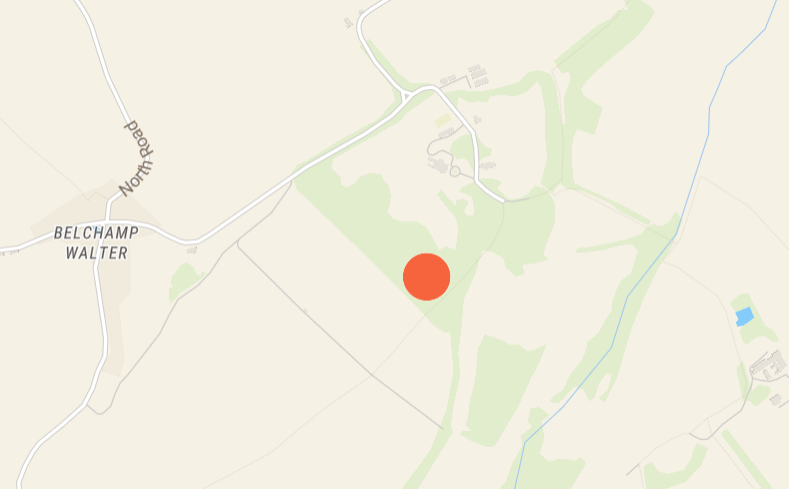
As at 1086 - the date of Domesday
There were:
- Households: 15 villagers. 7 freemen. 18 smallholders. 8 slaves.
- Ploughland: 4 lord's plough teams. 10.5 men's plough teams.
- Other resources: Meadow 70 acres. Woodland 20 pigs.
Livestock in 1066: 2 cobs. 24 cattle. 80 pigs. 160 sheep.
Livestock in 1086: 2 cobs. 28 cattle. 100 pigs. 200 sheep.
Definition of terms
Many of the terms taken from Domesday are derivations from the Latin and are historical useages and modern meanings may be a lot different to what they appear in a direct presentation.
The usage of the term "slaves" is more likely to be seen as "serfs" in more pc text.
The original text from Domesday:
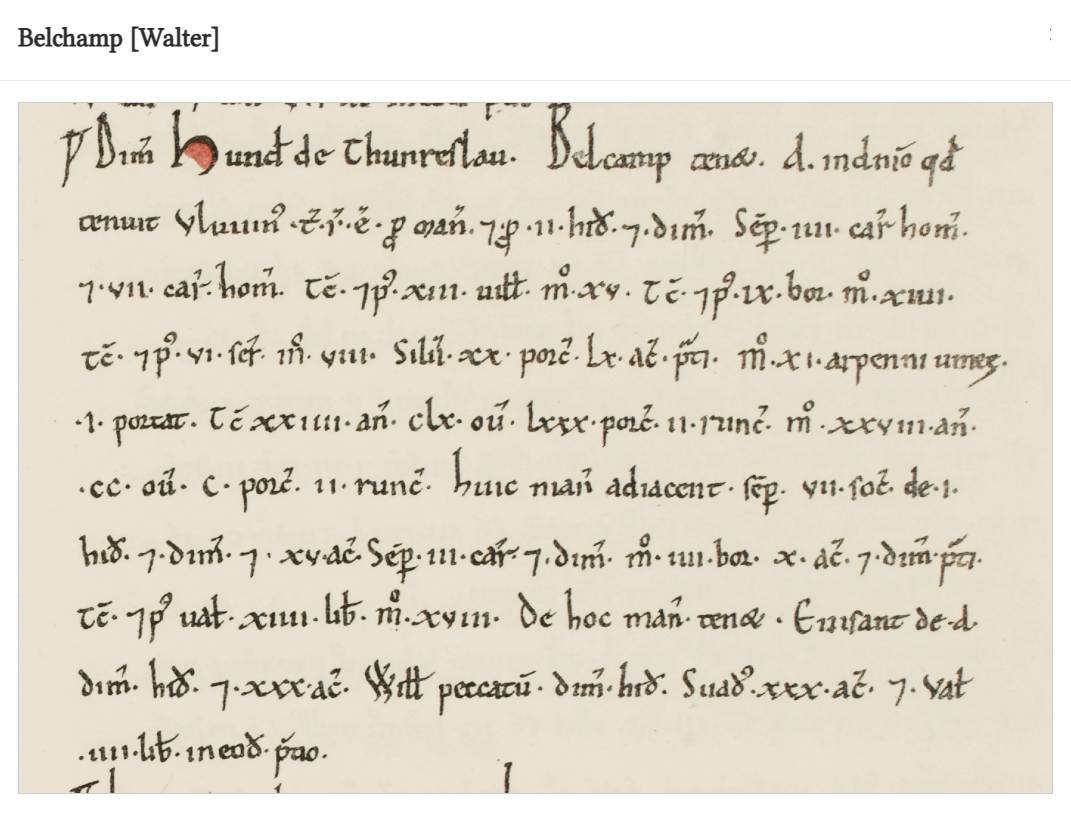
As can be seen it is far from clear that Thunreslau can be written or known as Thunderlow. The Belcamp, followed by text that means nothing to me (Latin?), is taken as the location for Belchamp Walter as opposed the the Belchamp reported to be "held" by the Canons of St. Pauls.
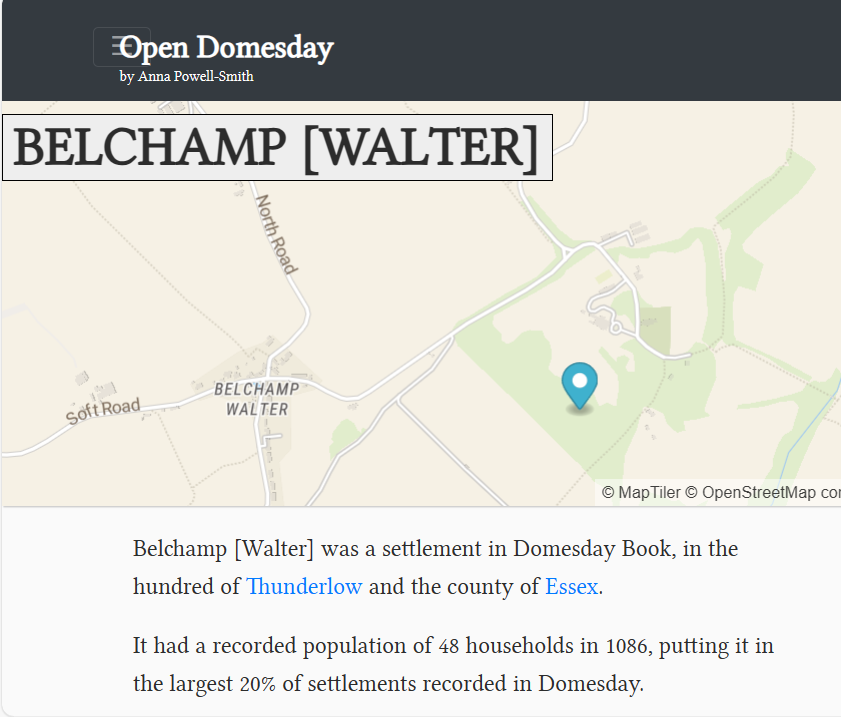
The interactive interface of Open Domesday is great to get a general feel of what the make-up of the region was in 1086 but how accurate is it?
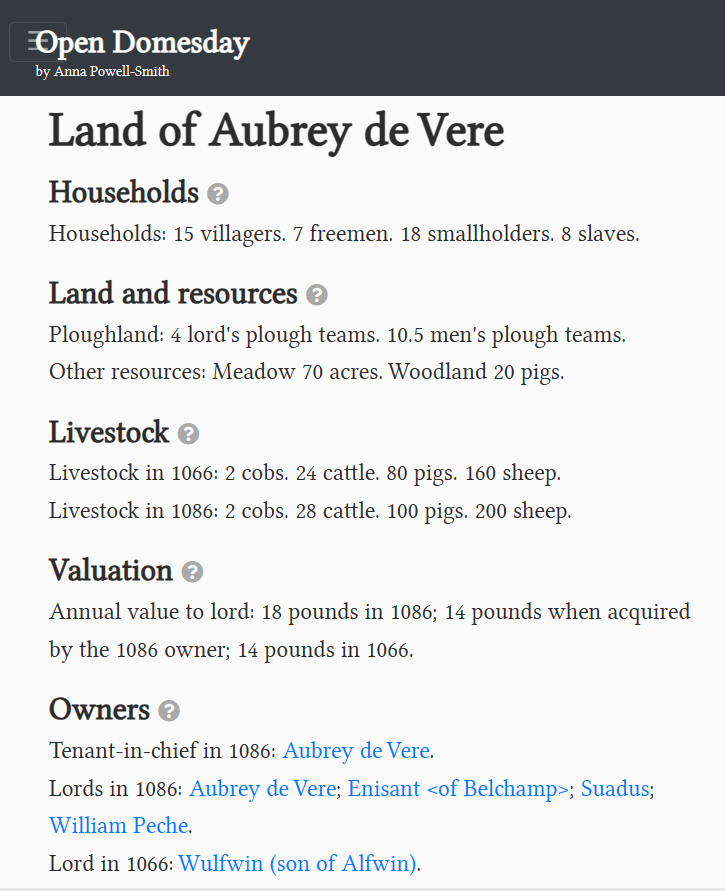
Also, the Tenant-in-chief in 1086 is categorically stated as Aubrey de Vere. While this may have been the case it is a gross over-simplification around this may have been the case.
The de Vere family are undoubtedly associated with the region but the reasons why are unclear and the subject of further research.
The Victoria History text from Domesday
The text from the Victoria History of the Counties of England (1901) on the region of Belchamp Walter seems to be similar to that seen in Open Domesday but you can see how it has been edited for "modern" readability:
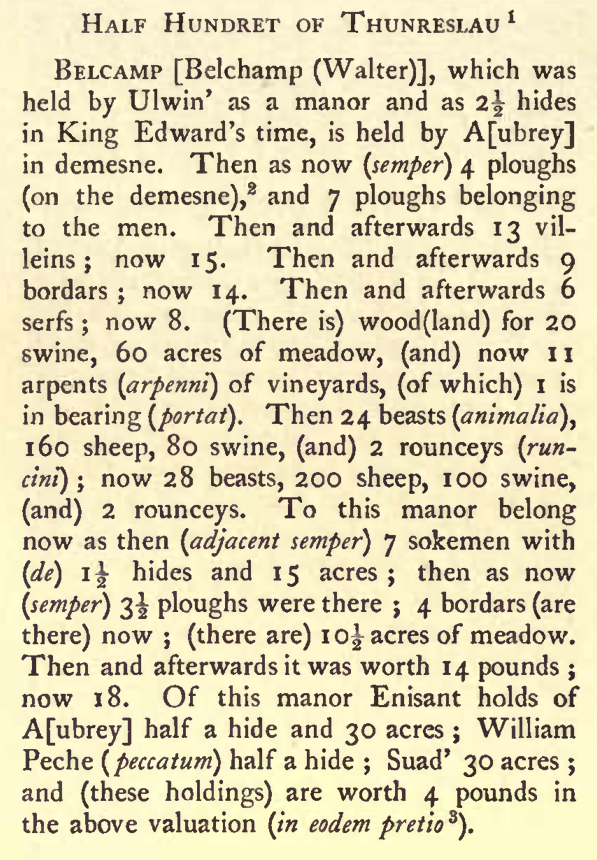
As you can see if you compare the text from Victoria History with that facsimile from the actual Domesday Book (as presented in the Opendomesday database) there are significant differences between that text and that presented in the translation in the Opendomesday entry. What Anna and the Hull Domesday Project have done is to organise the data to compare numbers between 1066 and 1086. While this would make sense in document that gives an account of what happened in the first 20 years of Norman occupation it does little to give the reader much more of a clue to what went on befor 1066 and the years after 1086. The later years saw much re-assignment of lands amongst the feudal lords and having a record of just this 20 year period does little for the understanding of what happened after William's death, the influence of his sons, future kings of England, and who they "assigned" the areas of the country.
The Victoria History makes it clear that it is far from certain where Thunreslau actually was located and the Half Hundreds of Belcamp and Ballingdon on the Essex/Suffolk border could be confused with the region around Saffron Walden (Bishops Stortford).
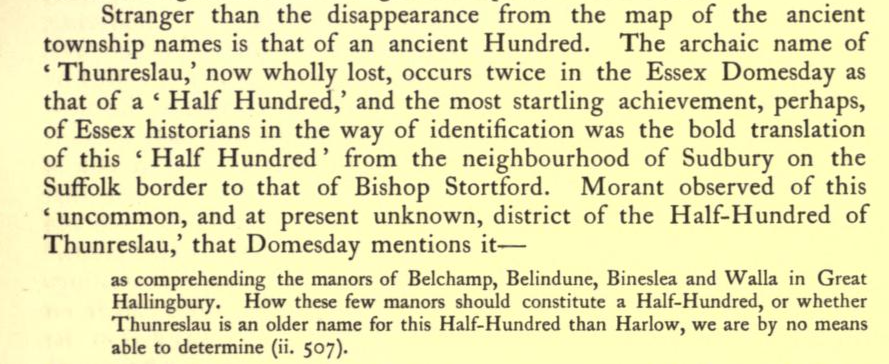
Morant, the much respected historian on the county of Essex, could not be certain about the location of Thunrelau (Ballingdon and Belchamp Walter):
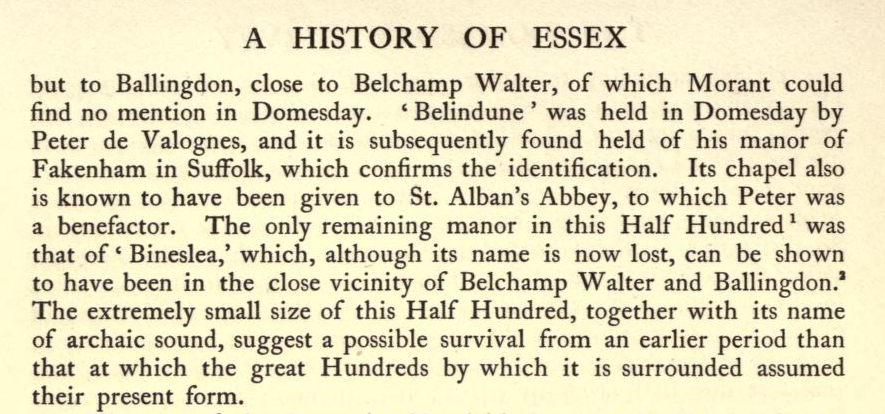
Morant is also (possibly) mis-quoted by Reaney with respect to the naming of Belchamp Walter and the assocation of the name of Walter de Tey.
HALF HUNDRET OF THUNRESLAU* BELINDUNE [Balingdon 6], which was held by Alvric, a free man, as a manor and as 3^ hides in King Edward's time, is held of Peter by Ralf ' fatatus.' Then as now (semper) 2 ploughs on the demesne, and i plough belonging to the men. Then and afterwards 3 bordars ; now 9. Then as now (semper) 4 serfs. (There are) 33 acres of meadow.7 Then 5 cows with calves, and 30 swine ; now 33 beasts (anima/ia), and 28 swine. It was then worth 40 shillings ; now 100. BINESLEA [ 8], which was held by Ulwin' as I hide in King Edward's time, is held by Peter in demesne. Then as now (semper) i plough on the demesne, and half a plough belonging to the men, and 1 3 bordars. Then and afterwards 2 serfs ; now I . (There is) wood(land) for 20 swine and 4 acres of meadow. It is worth 20 shillings. Pfeter] (holds ?) this land in mortgage (in vadimonio) by the king's command, but so that the dues should not be lost,' the Bishop of Bayeux being witness.