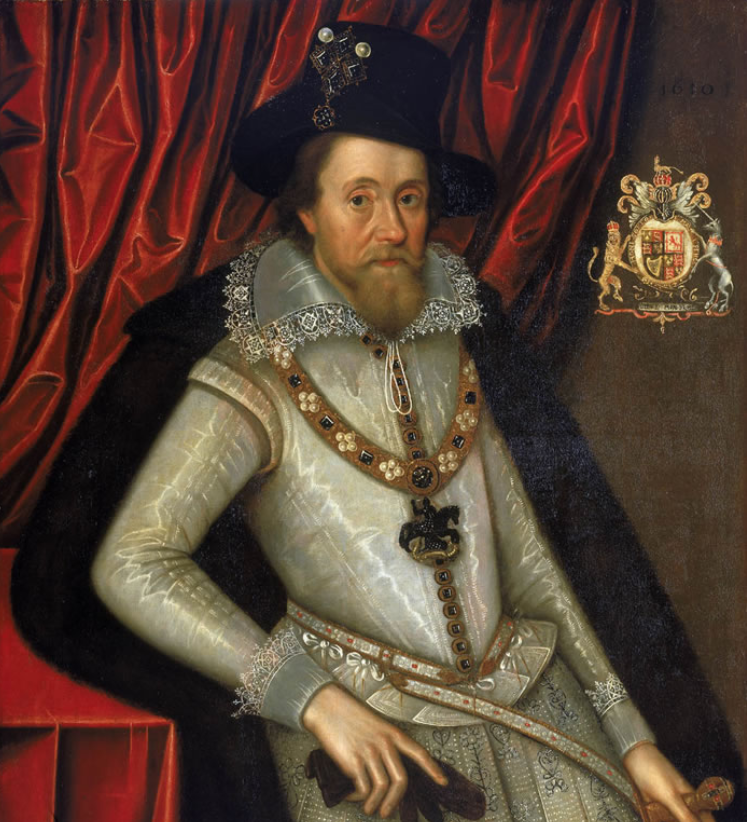
Belchamp Walter and the Jacobean Years
Elizabeth I - the Percy Family
The years spanning the crowning of James I and the fate of Charles I must have been significant to the history of Belchamp Walter.
How Belchamp Walter's history was shaped by the English Civil War
The reign of James I is significant to Belchamp Walter's history in that the Raymond years started at that time. The changes in the English monachy after the death of Queen Elizabeth saw the prospect that things that may have seen the resurgence of Catholicism in the kingdom.
James I was a Stuart and the son of Mary Queen of Scots. In 1565, Mary married her half-cousin Henry Stuart, Lord Darnley; they had a son, James.
King James I - James VI of Scotland - reign 1603-1625
The coronation of James I in 1603 saw the knighthoods of
Sir William Harris and John Wentworth.
John Wentworth was created a Baronet in 1611 and sold Belchamp Walter
manor to John Raymond.
When King James I came to the throne of England in 1603 this was only 2 years before the Catholic unrest that was
evident with the excapades of Guy Fawkes and Robert Catesby in the Gunpwder Plot of 1605.
James was the son of ??? and Mary Queen of Scots (need to check this) and the English Catholics were hopeful that he would
convert to Catholicism, he didn't much to their disappointment.
King James was the commissioner of the King James Bible which was commissioned in 1604 and published in 1611.
The Book of Common Prayer 1662) was presumably based on this first edition.
Top
Belchamp Walter
The relevance of what was going on in Belchamp Walter during the reign of James I is interesting. The ownership of the Estate
changed from the Wentworth's of Gosfield to the Raymond's of Hertfordshire. The Parish vicar, William Smythies, resigned and
took up a position in Gosfield and William Harris was knighted at James I's coronation and is
recorded as being a participant in the previous Centuries Spanish Armada. Sir William and Lady Harris are comemorated
in the current Belchamp Hall in the form of a portrait of Lady Harris
Wikipedia:
James VI and I (James Charles Stuart; 19 June 1566 – 27 March 1625) was King of Scotland as James VI from 24 July 1567 and
King of England and Ireland as James I from the union of the Scottish and English crowns on 24 March 1603 until his death in 1625.
Charles I
Charles was born into the House of Stuart as the second son of King James VI of Scotland, but after his father inherited the
English throne in 1603, he moved to England, where he spent much of the rest of his life. He became heir apparent to the
kingdoms of England, Scotland, and Ireland in 1612 upon the death of his elder brother, Henry Frederick, Prince of Wales.
An unsuccessful and unpopular attempt to marry him to Infanta Maria Anna of Spain culminated in an eight-month visit to Spain in 1623
that demonstrated the futility of the marriage negotiation.
Two years later, shortly after his accession, he married Henrietta Maria of France.
The difference between a Baronet and a knight
According to Britanica:
Baronet, British hereditary dignity, first created by King James I of England in May 1611. The baronetage
is not part of the peerage, nor is it an order of knighthood. A baronet ranks below barons but above
all knights except, in England, Knights of the Garter and, in Scotland, Knights of the Garter and of the
Thistle.
In England and Ireland a baronetcy is inherited by the male heir, but in Scotland ladies may succeed
to certain baronetcies where it has been specified at the time of their creation.