The Conqueror
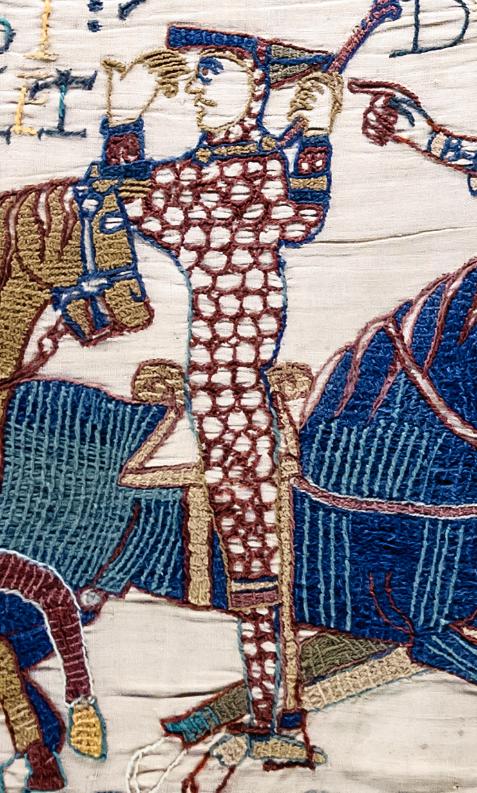
The story of the Norman Conquest is told by many historians and shown graphically on the Bayeux Tapestry.
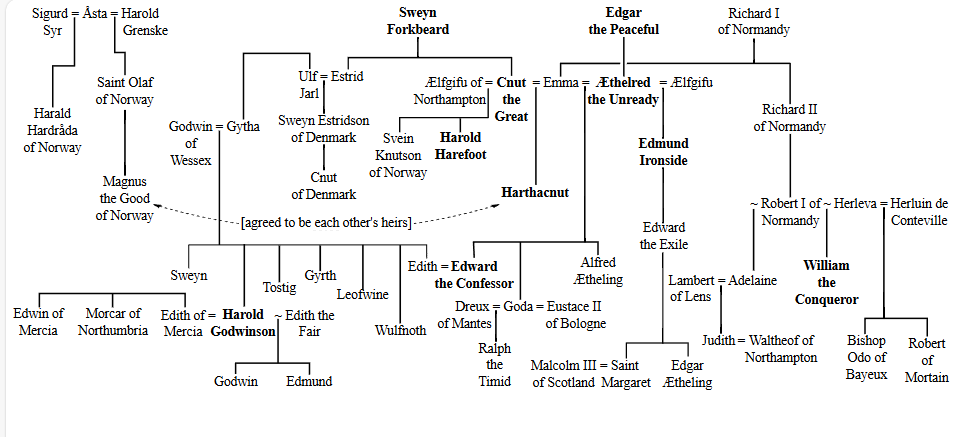
The events that led up to the Conquest are also depicted on the tapestry (embroidery), Edward the Confessor was not long-dead before he was succeeded by Harold Godwinson
The possible connection by geneology or service of the de Vere family and the descendants of Rollo.
William the Conqueror - 1066 - 1087
As most local histories of villages and towns in England have references to Domesday
it seems fitting that the life of William I needs to be put into context.
William did not spend much time in the country that he "Conquered". He returned to Normandy soon after
the conquest to attend to matters in Normandy and the conflicts that he had with the other Norman
barons and with France. He returned to England in 1085 to defend the country against King Sweyne of
Denmark. It was for this purpose that he commissioned Domesday.
William died in 1087 in a battle over Vexin and Maine (Mantes). His body was taken to Caen for burial
in the cathedral. The history books are not clear on who who was fighting but it was likely the French under
Philip II (reign. 1165-1123). The Vexin remained under dispute well into Richard I's reign and Philip
had "run-ins" with Henry II and King John.
William the Concqueror was succeeded by William Rufus (William the 2nd).
The relevance of William the Conqueror to
Belchamp Walter's history is the allegences of the subsequent
"players" for the throne of England. The crowning of King Stephen and the conflicts between his supporters
and the Empress Matilda determined the fate of those that "held" or controlled the local region.
His son king Henry I died in 1135 having wanted his favourite son William
Adleline
to be his heir, but Adleline was drowed in the White Ship Disaster and
Steven took power much
to the dismay of the Empress Matilda.
Top
Robert Curthose
Robert II of Normandy (c. 1051 – 3 February 1134
According to Wikipedia:
"
.... was the eldest son of William the Conqueror and succeeded his father as Duke of Normandy in 1087,
reigning until 1106. Robert was also an unsuccessful claimant to the throne of the Kingdom of England.
The epithet "Curthose" had its origins in the Norman French word courtheuse 'short stockings' and was
apparently derived from a nickname given to Robert by his father; the chroniclers William of Malmesbury
and Orderic Vitalis reported
that William the Conqueror had derisively called Robert brevis-ocrea ("short boot").[1]
"
The Siege of Ely - 1070
Following the Danish raid of 1069 King Sweyn II and Hereward the Wake
William's final years were marked by difficulties in his continental domains, troubles with his son, Robert,
and threatened invasions of England by the Danes. In 1086, he ordered the compilation of the Domesday Book,
a survey listing all of the land-holdings in England along with their pre-Conquest and current holders.
He died in September 1087 while leading a campaign in northern France, and was buried in Caen.
His reign in England was marked by the construction of castles,
settling a new Norman nobility on the land, and change in the composition of the English clergy.
He did not try to integrate his domains into one empire but continued to administer each part separately.
His lands were divided after his death: Normandy went to Robert, and England went to his second surviving
son, William Rufus.
Harald Hardrada
Harold Godwinson
King Sweyn II
King Sweyn II of Denmark was planning an invasion of England in 1085 and William returned to England
with many mercenaries in anticipation of an attack. This also prompted the commissioning of the Domesday
survey to assess his wealth to provision his armies. Aparently the survey was not used by William and
Sweyn did not invade.
Never-the-less the survey proved to be of much use to historians. There even could have been a de Vere
amongst those arriving in 1085 from Normandy.
William returned to Normandy to continue his conflict with Philip of France, loosing his life after being
wounded in an assalt on Mantes in the Vexin. He was victorious but the region was still in dispute after
his death and William Rufus was supposed to regain the Vexin
Hereward the Wake
After some research into why William FitzOsbern was not featured on the Bayeux Tapestry I find that
the embroiderors of Norwich Castle have created their own tapestry depicting local events.
Edward the Confessor
Edward the Confessor
William FitzOsbern
William FitzOsbern, 1st Earl of Hereford, Lord of Breteuil (c. 1011 – 22 February 1071), was a relative
and close counsellor of William the Conqueror and one of the great magnates of early Norman England.
FitzOsbern was created Earl of Hereford in 1067,[a] one of the first peerage titles in the English peerage.
He is one of the very few proven companions of William the Conqueror known to have fought at the
Battle of Hastings in 1066. His chief residence was Carisbrooke Castle
on the Isle of Wight, one of many castles he built in England.
Richard - Duke of Bernay
William's second son often gets overlooked. Robert Curthose, his oldest and Duke of Normandy, and his younger brother William Rufus get far more coverage.
Wikipedia said:
Richard of Normandy (c. 1054 – c. 1070) was the second son of William the Conqueror, King of England, and Matilda of Flanders.
Richard died in a hunting accident in the New Forest in a collision with an overhanging branch, probably in 1070 or shortly afterwards.[1] He was buried at Winchester Cathedral. His younger brother, King William Rufus, was also killed in the New Forest in 1100.
Richard is sometimes referred to as the "Duke of Bernay", as if part of his father's continental possessions, as in Burke's Peerage; this is a mistake based on the misinterpretation of a 16th-century inscription on his tomb, which was also intended for the Earl Beorn, nephew of Cnut the Great.[2]