de Beauchamp, de Mandeville and de Vere connections
William de Beauchamp - 13th Century - de Vere as Brother-in-Law of William I - Geoffrey de Mandeville - The Barons of Bedford (bedford.html)
The essay/memoir published in The Publications Of The Bedfordshire Historical Record Society Volume I confirms quite a few assumpsions made about the History of Belchamp Walter and surrounding area. The mysteries of the 12th and 13th Centuries and the interconnect between the noble families is unpicked here. The memoir fills in some of the unexplained statements made by Thomas Wright and other historians. John Horace Round is quoted and is also a source used by Wright.
There is a lot of information relating to the de Beauchamp family here and I need to complete the transcript from the Bedfordshire Historical document. I have been getting visits to this page so it would appear that there is some interest.
There is a family tree in the Bedford document that has dates (beauchamp_bedford.png - on page on 12th C) - they are not very clear and need to be repeated on this page. the de Beauchamp family name while appearing in Domesday does not appear before that. i.e. they are not a Norman family that "came with the Conqueror". Much stock seems to written into many historical accounts including the Botetourts and the de Veres. In both these cases there is little evidence of this being the case.
However, the de Beauchamp family are a very prevelant family in the 12th and 13th centuries. There is even inter-marriages between the de Veres, the de Mandevilles, the de Botetourts, the Fitz Othos, the Montchensys and other families.
Taillebois - Ralph Taillebois, was High Sheriff of Bedfordshire before 1086
The fact that I am getting multiple impressions on my Barons of Bedford page indicates that there is some interest here. As I say above I need to complete the transcription.
Saw a log entry: /Belchamp_Walter/barons_of_bedford.htm HTTP/1.0 - this does not exist!Looks like someone on a fishing expedition - knows about underscore though.
Essex/Bedford Connection
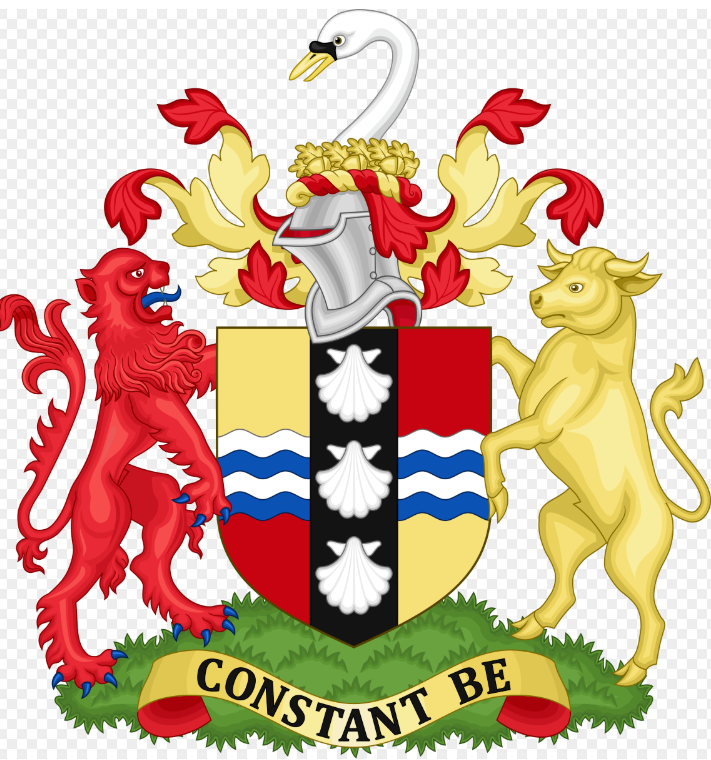
At first glance you may be wondering what this connection is all about.
The de Beauchamp family are well known as being associated with Bedfordshire and Warwickshire the connection to Essex is through the marriages of Rohse de Vere of Castle Hedingham and Geoffrey de Mandeville, who was probably related to the de Veres.
(The two coats of arms are too similar) and that of Beatrix de Beauchamp and Thomas Fitz Otto and finally Maud Fitz Otto to John de Botetourt.
The dates from the Bedford Historical Record Society are from pre-Conquest up to the 14th Century. In retrospect Thomas Wright was more interested in "getting as many family the names in his text" rather that presenting a chonological account. The "maneuvers" of the 12th and 13th Centuries are difficult to follow for the country in general, to explain what went on in our region is even more difficult. In any case, most readers are not interested in this part of history.
de Vere and de Mandeville for Essex
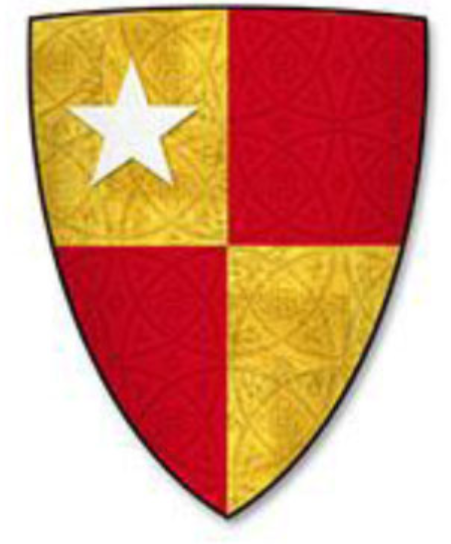
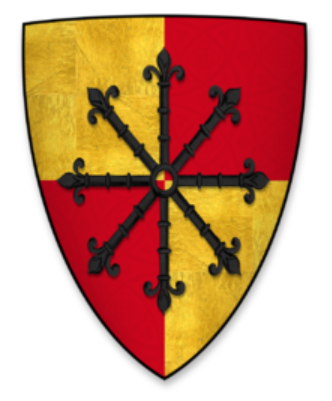
de Beauchamp for Bedford
Not only has the de Beauchamp family have ties to the region of Belchamp Walter there is another commonality of the involvement of the de Veres and de Beauchamp as Magna Carta Barons.
The Bedfordshire Historical Record Society - 1912
There is no evidence of the presence in England of any Beauchamp earlier than Domesday Book; and the only Beauchamp there mentioned by name is Hugh de Beauchamp of Bedford. But the Walter named as a subtenant of some property in Worcestershire, under Urse d'Abitot and others, may be identified, almost certainly, with the Walter de Beauchamp who married Urse's daughter [1] and succeeded to his great estates, as also to the title and some of the lands of Urse's brother, Robert the Dispenser [2]. No evidence of any relationship between Walter and Hugh has been adduced as yet.
Of the origin of the founder of the family nothing appears to be known. His name—de Bello Campo, Belcamp, or Beau Champ — is evidently taken from one of the several places of that name, the "Fair Field," in Normandy or Picardy.
Mr. Round ingeniously suggests that it is to be sought in the Calvados. [3]
The Roman figures after the names of the Beauchamps refer to their position in the family table at the
end of this memoir. The B. (standing for Bedford), is added after the figure, in order for the future to distinguish them from their contemporaries, the Beauchamps of Eaton Socon, who often bore the same fore-names; that family, it is hoped, will form the subject of a future article by the present writers
Walter de Beauchamp was one of Henry I's "New Men"
HUGH DE BEAUCHAMP (1. B.)
was the founder of the line. He appears at Domesday (1086) as holding some 43 manors; these lay almost wholly in Beds.; he had, however, a fifteen-hide manor at Linslade, a four-hide manor at Lathbury, and a small holding in Soulbury, all in Bucks.; as well as the six-hide manor of Bengeo, co. Herts.; the four hide manor of Hunsdon, [4] in Herts., was also "of his fee." The method by which he acquired the Bedfordshire lands has been discussed in the " Notes on Domesday " below. Ralf Taillebois, who there is suggested to have been Hugh's father-in-law, seems to have been succeeded by Hugh in his public capacity of Sheriff, as well as in his lands. Ralf had been Sheriff of Bedfordshire before 1086,^ but had died before that date^ the inference that Hugh succeeded him as Sheriff is strongly supported by two precepts of William the Conqueror.^ The first of these is addressed to Ralf Taillebois and Peter de Valognes "and all faithful servants French and English in whose Sheriffwicks (vicecomitatibus) or bailiwicks (ministris)," etc.
The second is addressed to Peter de Valognes and Hugh de Beauchamp "and all my sheriffs." From other sources we know that Peter de Valognes was Sheriff of Essex and Herts. In 1086, and that Ralf Taillebois was Sheriff of Beds, before that date ; the inference is that Hugh de Beauchamp replaced Ralf in his office.
Hugh witnessed a charter of William II. [8] and another of 1080.[9] But there is evidence that Hugh lived on into the reign of Henry I.; by a charter preserved in the Newnham Cartulary, [10] is recorded that the King gave Stanbridge [co. Beds.] to his Queen Matilda, and that she gave it with his consent to Hugh de Beauchamp; this charter must have been given between Matilda's marriage (1100) and her death (1118)
Mahald (Matilda) de Beauchamp
MAHALD (MATILDA) DE BEAUCHAMP, is named as the mother of Simon (I. B), alive between 1124-1130, in a document [11] which will be discussed below. A possible parentage for her is suggested on p. 67.
Simon de Beauchamp (1. B.)
SIMON DE BEAUCHAMP (1. B.)
Very soon after the latest date to which our evidence for the existence of Hugh de Beauchamp can be ascribed, we find Simon in possession of the Bedfordshire estates. Several documents of the Abbey of Ramsey refer to him, either as a witness, or in connection with rights of boundary and so forth, at Holwell, and Pegsdon (Beds.) and North Crawley (Bucks.)
Three of these are dated by the editor of the Cartulary as between 11 14 and 1130. One^^ is a notification by Henry L to the Sheriff of Bedfordshire that Reginald, Abbot of Ramsey, has granted to Simon de Beauchamp "land of Holewelle," on condition that he perform the service of one knight fully in all things; in later records we find that his successors recognised that service. In a second document^* Richard de Lucelles covenants with the Abbey for the use of water rising at Pekesdene (Pegsdon in Shillington), and necessary for his mill; he will get the confirmation of his lord Symon de Pulchro Campo (clearly a monastic flourish for Bello Campo or Beauchamp).
The third^^ is of particular interest, as it furnishes the only known evidence for the name of Simon's mother, Mahald or Maud. It is a notification (assigned by the editor to 1124-1 130) of the settlement of a dispute about a boundary; three brothers FoHot quit their claim as the result of an inquisition or inquiry on the oath of twelve men who represented three neighbouring lordships:— four for the Abbot's lordship of Cranfield, four of Walter de Bolebec's men of [North] Crawley, four men of Simon de Beauchamp and his mother Mahald. The land is said to be of the fee of William de Hocton, and David King of Scots is tenant in chief ; the deed must refer to the northern boundary of Cranfield, where it marches with North Crawley and a thin strip of Kempston (of the latter the King of Scots was tenant in right of his Earldom of Huntingdon). Which Beauchamp lordship was represented by the men of Simon and Mahald is not stated, but was probably the adjacent Stagsden ; the mention of mother and son together suggests that she was holding the lordship either in dower, or as her marriage portion, or perhaps as guardian of her son. As no document as yet has been found to give the name of any holder of the Beauchamp estates between Hugh and Simon, we may suppose, till contrary evidence is produced, that Simon was the son of Hugh of Domesday Book.
In a further deed^^ from the same source, the king confirms a grant by which Simon quits in favour of the Abbey his claim to woodland in Crawley for 20 marks and 2 palfreys; the editor dates this as of about 1129.
He was a benefactor of St. Alban's Abbey^^ ; and his name occurs in the Pipe Roll of 1130-1^^ as rendering account for a large sum " for the bail of his man whom he did not hold to right." He witnessed Stephen's Oxford Charter of Liberties and grant to Winchester in 1 136 as Dapifer, or royal steward^^ ; and he probably died very soon afterwards.
As there is still considerable uncertainty as to the exact relationship between Simon and his successor, it is worth while to set out here in full the available evidence. Two contemporary writers have left an account of Stephen's siege of Bedford Castle at the end of 1 137 and beginning of 1138. The Gesta Stephani states^^ that at this time Miles de Beauchamp had custody and command of the castle by royal licence (Milo de Bello Campo castello Bedfordie ex regia permissione custos presidebat) ; and that he received the order to render up the castle and the duty of service which he owed to the king (ut et castellum Beflfordie et quam sibi debebat seruicii uicem . . . exhiberet) to Hugh " pauper," brother of Walerand Count of Meulan, whom Stephen seems to have created Earl of Bedford^\ Miles answered that he was ready to obey the King, except in so far as he should try to remove him from a possession which was due to him and his by right of his father (ni se a possessione ex paterno iure sibi et suis debita amouere temptaret). It will be observed that the precise relationship of Miles to his predecessor is not stated, and that no mention is made of any brother of Miles. But another contemporary authority relates the same occurrence, with some other details: — Orderic Vitalis, a monk of English birth (though he lived at the Abbey of St. Evroul from his tenth year) and a diligent gatherer of authentic information. In explanation of the siege, he says that the sons of Robert* de Beauchamp held the fortress, and they feared to lose their whole inheritance, for they heard that the King had given the daughter of Simon de Beauchamp, with her father's honour [or barony] to Hugh, surnamed "pauper" (filii Roberti de Bello Campo munitionem tenuerunt .... quia Regem Hugoni cognomento pauperi filiam Simonis de Bello Campo dedisse cum patris honore audiuerunt totam hereditatem suam amittere uerentes.)^^ From these two accounts we may conclude that Miles had at least one younger brother; that he was not the son of Simon; and that Robert the father of Miles was dead or out of England.
ROBERT DE BEAUCHAMP
as will be apparent from the foregoing evidence, was possibly the son of the Hugh of Domesday Book, the brother of Simon (1. B.) the Dapifer, and the father of Miles and his brothers. The translator of Ordericus Vitalis regards" Robert de Beauchamp, Viscount of Arques, as a member of the family, but cites no evidence in support of the suggestion; if it be correct, this is probably the same man, and the man who witnessed a charter given at Rouen between 1111-1118, and another between 1103-1106.^* No evidence has yet been found to show that Robert ever held the Barony of Bedford, which seems to have descended directly from Simon to Payn
Miles de Beauchamp
MILES DE BEAUCHAMP (I. B.)
In the Pipe Roll of 1130-1 Miles was excused for Danegeld in Beds, and Bucks. He witnessed a charter to Shrewsbury Abbey^^ dated by Eyton about 1138 to 1141, the second charter of the Empress Matilda to Geoffrey de Mandeville in 1142, and others about the same time.^® As being the only brother mentioned by name at the defence of Bedford Castle in II38^^ and as appearing in the Pipe Roll of 1130-1, while Payn does not so appear, he was probably the elder of the
surviving brothers; but, if so, he must have died with out heir male, since Payn certainly inherited the Barony.
By 1141 Miles had recovered Bedford Castle from
Hugh Pauper.^^
The subsequent history of the castle during Stephen's reign is obscure; but its possession was obviously contested.
In 1146, Ralph, Earl of Chester, who had been among Stephen's opponents, went over to his side; "coming with the King, he manfully took the city of Bedford, which had ever weakened the royal power, and committed it when taken to the king."^^ A story in Blomefield's History of Norfolk, there assigned to "about 1150," probably refers to this attack.^" The castle may then have been held for Stephen till 1153, when Henry Duke of the Normans (later our Henry II.) appears at least to have attacked it^^'; after the reduction of the castle of Crowmarsh (Wallingford), he is recorded as having besieged Stamford, and thus appears to have captured Bedford on his way; two years later the burgesses of Bedford owe 20 marks to the Exchequer,^^ " because they were in the castle against the King."
An entry in the Testa de Nevill (p. 260), that " Miles owes 52 knights in the county of Bedford " is probably a scribal error. If correct, it could only refer to this Miles, and would indicate that he preceded Payn in the barony, which is quite possible; but other entries of the same batch deal with men who lived later than John and Richard I. ;
that is, later than any Miles of the Bedford family yet traced, though the name persists in the family of Beauchamp of Eaton [Socon].
The compiler of the Testa was, therefore, probably mistaken.
The Annalist of Bermondsey probably intended to refer to this Miles, when he recorded^^ that the mill of Bedford was given to Bermondsey by Miles with the consent of his heir Payn in 1181; the date seems impossibly late, but this annalist's dates cannot be relied upon; there is a confirmation of this gift by Henry 11.^* The mill belonged to the Bedford family, for Simon (H. B.) granted a tenth from it to St. Paul in Bedford at a later date.^^ The entry there
fore probably refers to Miles (I. B.) ; and " Payn his heir " (not " son and heir ") was in that case probably his brother, and probably younger.
Payne de Beauchamp
Payne de Beauchamp was the second husband of Rohse de Vere. (see also my page on the Barons of Bedford
Payne de Beauchamp
That he was a brother of Miles (I. B.) we know from a charter to Shrewsbury Abbey. [36] He himself was a benefactor to the Canons of St. Paul in Bedford, who were afterwards constituted the Priory of Newnham; [37] between 1147 and 11 53, he and his wife were benefactors of the Priory of Chicksand. [38] About 1 144 he married Roheis, widow of Geoffrey de Mandeville, first Earl of Essex, and daughter of Aubrey de Vere, Great Chamberlain and Justiciary. Before 115 5-6, when apparently his property was at farm for his son Simon [39] (II. B.), he was dead.
The connection de Vere, de Mandeville, de Beauchamp families are not clear from my previous research. There is an obvious connection through the heraldry, but in a similar manner to taking what is written in Inquistions Post Mortem I don't think that this a sound basis for definite conclusion.
The priory at Chicksands was founded by Payne and Rohse but there also seems to have been more patronage from the de Beauchamp family as the Priory is mentioned elsewhere in the text..
The manor Wootton is another example of "History by IPM". The Inquisition records the transfer of the manor but does not give the reasons why.
In addition, the connection between de Mandville and de Botetourt families can somewhat guessed if you read between the lines of the Bedford text. The marriage of Beatrice de Beauchamp to Thomas Fitz-Otto (who could have been the sister of Payne and/or Miles).
Maud Botetourt was their daugther and the wife of John Botetourt.
Ellen de Beauchamp
ELLEN DE BEAUCHAMP
is named*" as having granted land at Stotfold (co. Beds.), to St. Paul of Bedford, and as aunt (auuncula) of Simon (II. B). That Stotfold was still Beauchamp land as in Domesday, is shown by the grant*^ of a fee there from this Simon to Roger de Saleforde (Salford, co. she was therefore presumably Simon's aunt by blood and not by marriage, and so sister of Miles and Payn.
She is probably also the "dominella Elena," who witnessed a charter of Payn and Roheis de Beauchamp to Thorney Abbey.*^ Further reference is made to her in the second charter to the Priory of Chicksand (Article 6)
Beatrice ed Beauchamp
BEATRICE DE BEAUCHAMP, who married Hugh de Moreville, may have been a sister of Miles and Payn. She had dower in Bosyate, CO. Northants ; with her husband she founded Dryburgh Abbey about the middle of the xiith century.*^ A gift by her to the Abbey was confirmed by David I., King of Scots, between 11 50 and 1153/*
Simon de Beauchamp
SIMON DE BEAUCHAMP (II. B.).
That he was son of Payn and the Countess Roheis is amply proved from many sources, for instance, from the Newnham Cartulary/^ His name first appears in the Pipe Roll of 1155-6; for nine years his lands were at farm, and accounted for by the Sheriff or others; but in the Pipe Roll of 1164-5 he renders his own account; if of age when he succeeded he must have been born about 1144-5, and if so his mother re-married very promptly after her widowhood.
At the great Inquest of 1166, [46] he returned 44 + ½ + ⅕ knights, and of those who " remained" (unenfeoffed)^^ 9 + ⅕ knights.
For some reason, unrecorded, and still evasive, he was impleaded by Guy de St. Walery of the whole Barony of Bedford, and for the sake of peace yielded to him the Manor of Aspley (Guise)^^; a fine to the Crown, probably imposed for this arrangement, was charged against him in the Pipe Roll of 1179-80 and subsequent years.
In 1189-90 (Pipe Roll) he paid looli. for custody of the Castle of Bedford. His debts to the Exchequer in the Pipe Roll of 1193-4 show his wealth, for he was charged 20 marks to avoid service in Normandy, 20 marks as fine on purchase of lands at Bedford (la Sela de Bedeford and Kingsmed), 200 marks for his shrievalty of the two counties, and 45li. 15s. 8d. as scutage for ransom of King Richard from the Germans.
This last Scutage appears to have been at the rate of i li., and would therefore represent 45 + i + i fees, the actual number given in 1201^®; a comparison of this number with the number charged in the scutages of 1 167-8 and 1171-2 seems to show that the assessments " de novo feoffamento," introduced after the Cartae of 1166 for un-enfeo£fed knights,^^ had been dropped; they do not re-appear on the scutages of this Barony.
Simon gave the advowson of Astwick to the Priory of Chicksands^^ in 1 198-9. He held a knight's fee of the Abbey of Ramsey in Holwelle or Holywell/^ where William (I. B.), his son held three and a half hides in 1253. He was at the Council of Clarendon in 1164/^
In either 1179 or 1189 (shrievalties of William Ruffus) he gave to the Hospital of St. John in Bedford his chapel, at (or on) the bridge of Bedford;^* he also made grants to Wardon Abbey.^^
Simon was Sheriff of Beds, and Bucks, from 1194-5 to 1 196-7; by 1206 he was dead (Pipe Roll). He married IsalDella/® whose parentage has not been traced; by her he had several children.*
* On the Beauchamp pedigree in his " Hundred of Willey," Marsh Harvey shows Elias de Beauchamp, the husband of Constance de Bolebec, as a son of our Simon, I.E. This seems to be a pure guess on someone's part. Elias, who seems to have been one of the Beauchamps of Somerset, was probably a son of Ralf de Beauchamp, [57] and Matilda, daughter of Geoffrey de Limesia; [58] he had brothers Andrew, John, and William.
Hugh de Beauchamp II
HUGH DE BEAUCHAMP (II. B.)
a son of Simon II. B, has only been met in one reference/® but some of the references assigned to his contemporary Hugh of Eaton (III. E) may relate to him.
Simon de Beauchamp III
SIMON DE BEAUCHAMP (III. B.),
a son of Simon (II. B.) has only been identified by a single reference, as witness to a charter of his father.®'^ It is of course possible that some of the notes on his father may refer to him. By his position in the list of witnesses, he is likely to have been the Simon who at tested a charter to Wardon Abbey, between 1189 and 1 194"; and was probably the Simon who attested the great charter of William (I. B.) to Newenham.^^
William de Beauchamp (1. B.) - Magna Carta Baron
The significance of William de Beauchamp and the history of England and Magna Carta features highly on this website. The participation of William along with other local magnates, de Vere and de Mandeville, are of specific interest to thios website.
Other local earls include de Mowbray, de Clare, Bigod, Malet, Marshall and Percy.
WILLIAM DE BEAUCHAMP (1. B.)
succeeded to the Barony in 1206-7 (P.R.) therefore probably was born by 1 185-6. Of the fine of 600 marks and 6 palfreys levied on his succession, a part was to be paid by Haweis de Lanvaley and William her son,®^ mother and brother of his wife Gunnora,^* who brought Bromeleg' (Great Bromley, co. Essex), as her dower
The knights' fees charged against him on various aids and scutages were within a fraction of what his father left, always between 45 and 46 in number. In 1210 he was with the army in Ireland [66]
In the troublous times of King John he played a prominent, but not always successful, part. He joined with the other recalcitrant Barons at Stamford in 1215 [67]; and, during their great march on London, which ended in the grant of Magna Charta, he entertained them "reverently" at his castle in Bedford®^; but on his further march with them, the King sent Fawkes de Breaute against the castle, to whom it was surrendered and finally granted.®^ William, however, was at Runnymede, and signed the Great Charter; he was in the list of the Barons consequently excommunicated.^*^ He
was taken prisoner at the Fair of Lincoln^^ in 1217, but returned to "faith and service" of the King, Henry III., with whose army he was at Newark in 1218.^^ At Henry's accession, therefore, he had lost his castle, but his lands, including the mills outside Bedford called the Portmulnen," were restored to him, and he accounts regularly for his lands in the Pipe Rolls.
It had been decided by the counsel of the Magnates, that the castle should be restored to him, since it was part of the agreement with King Louis that " every man should have such seisin as he had at the be ginning of the war," and he was to hold "it in the same manner as his antecessors had held it."^^ Fawkes, however, had refused to deliver up the royal castles en trusted to him.
On the surrender of Bedford Castle in 1224, after the defiant action of Fawkes de Breaute, it was ordered that the outer bail and fosses should be levelled with the ground, and the walls of the inner bail pulled down to half their height; the latter were to remain without battlements, but William was to be allowed to cope them (crestare), and to build himself houses within them if he pleased/^
In 1234 he was appointed Baron of the Exchequer, simultaneously with Alexander de Swereford,^^ and in 1235 and 1236 he was Sheriff of Beds, and Bucks. At the Coronation of Henry III. and Eleanor of Provence in 1236, he acted as Hereditary Grand Almoner.^^ In 1244-5 he was with the army in Wales.
While he confirmed the gifts of his father and grandparents to the Priory of Newenham,^® he main tained most strictly his rights as its patron. In 1254, a new Prior having been installed on the Bishop's mandate alone, he and his second wife Ida made the Prior come outside the gates to seek installation at his choir.
hands; on his compliance, William was satisfied, took
him by the hand, and himself installed him in the
This was, however, apparently more than his right as patron, for, at the Bishop's next visitation, William's chaplain admitted that his master had exceeded his powers, and undertook that the patrons should not interfere with spirituahties in the future.
It was probably for a similar reason that, in 1247, on the appointment of a previous Prior during William's absence abroad, his steward came to loggerheads with Newenham—at the instigation, it was said, of Ida, the second wife.^^ William had trouble also in 1254 with the Abbot of Warden, who brought seventeen pleas against him before the Justices in Eyre at Bedford.
Although in the town at the time, he refused to appear before them. They appealed to Richard, Earl of Cornwall — then Regent during Henry's absence in Gascony — who told them to "omit nothing for the doing of justice " ; thereupon they seized William's barony for contempt.
He was, however, mainperned by Simon de Pateshull and others; and the Earl of Cornwall directed the Justices, who by then had already reached Staffordshire on their eyre, to hear and determine the At the same' time the Sheriff of
Bedfordshire was ordered to restore his lands.
This seems to have been done at once, for the Barony does not appear from the Pipe Rolls to have been put to farm or escheated. How the seventeen pleas of the Abbot fared is not told; they were probably a step in a dispute, which began in 1252, about Rights of Free Warren, which the Abbot had bought from the King^® behind the back of the Overlord. Probably, in endowing Wardon with lands, the Beauchamps had reserved their " sporting rights "
;
indeed, it appears from pleadings de quo warranto that a tenant had no power to transfer rights of warren. In these differences of opinion with Churchmen* on matters of law or feudal and patronal rights, we have found no evidence whatever of William's " tyrannical oppression," of his being " an enemy to the religious of the neighbourhood," and " an enemy of the public peace "— phrases with which he has been branded recently, and apparently without due consideration of the available evidence.
It is certainly the case that Matthew Paris speaks harshly of him; against this may be set the fact that the chronicle known as that of Matthew of Westminster speaks in praise of his behaviour to the Church,^^ and he was undoubtedly its generous benefactor. We have met with some of these pleas of the Abbot of Wardon (and other churchmen) against William de Beauchamp in the rolls^^ ; they seem to have been ordinary suits to determine the extremely complicated relations which existed between the overlord and patron on the one hand and the religious house subenfeoffed of land by his vassal on the other.
As William claimed services from Wardon in fifteen Bedfordshire villages,®" these differences of opinion were not surprising. The only result of the Abbot of Wardon's seventeen suits which I have been able to trace was that he was fined 50 marks for a " false claim " against William!®^
The Wardon Cartulary is entirely silent as to these troubles, but records a very interesting convention of 1240 with William, mainly about water rights in Cogepol (Cople), Kerdyngton (Cardington), and Goldyngton; it also records his confirmation of Simon's grants, and a quit claim to pasture in " Hawnyes (Hawnes)^^
In right of his wife Ida, he was patron of the Priory of Newport Pagnell; in 1232 the Bishop filled up the office of Prior, which had been vacant for six months, and wrote to William that he had done so.^^
By 1257 he must have been at least 70 years old, probably much older; and, with the King's consent, he transferred the Barony of Bedford to his second son William (II. B.), on a fine of 500 marks.®*
He died in 1260®^; and parts of his Inquisition post mortem have been preserved.®®
Gunnora de Lanvelay
GUNNORA DE LANVELAY,
daughter of William de Lanvaley and Haweis his wife, was the first wife of William de Beauchamp (I. B.)®^
Married by 1207, she was dead by 1220, when William is found holding Newport Pagnell, the dower of his Hunts.;
second wife, Ida de Longespee.®^
She had by him a son John, who was dead by 1232, leaving an heir under age; the service of this heir was claimed^® by John de Burgo (I.) and Haweis his wife (niece of Gunnora), for half the vill of Hamerton, co. and Bromley, co. Essex, which had formed Gunnora's dower.
Of this heir nothing further has been found. Hamerton was held by the heirs of Beauchamp from the heirs of de Burgo for some time;^° but Bromley was to revert to Haweis de Burgo and her heirs at William de Beauchamp's death/"^ The
fine of 1234-5, which contains this last arrangement, seems to imply that Gunnora's grandson and heir was already dead.
Ida (Idonea) de Longespee
IDA (IDONEA) DE LONGESPEE,
the second wife of William (I. B.), was a first cousin of Henry 111.^°^ by blood, though not in law; she was
daughter of William Longespee, third Earl of Salisbury, son of Henry H. by an unknown mother,^"^ long supposed to have been " Fair Rosamond." She brought as dower from her first husband, Ralph de Sumery, the manor of Neuport^*'* (Newport Pagnell, co. Bucks.), and was apparently married before 1220, when William (I. B.), already held this manor.''^ Matthew Paris, always bitter against anyone who resisted the incessant encroachments of the Church, attributes to her influence her husband's disputes with Newenham and Warden, and says very unkind things of her;^°^ it is, however, obvious, even from his own account, that there were two sides to the story. Claiming to take her dower at her choice (ad libitum), she raided the manor of Craule (probably Little Crawley, co. Bucks.) ; she " pulled down houses, cut down trees, and did other enormous damage there,"against Simon de PateshuU ; but eventually she was fined for disseisin as a result.^^^ There had already been trouble between the Beauchamps and Simon de PateshuU, then Sheriff, a year or two previously.
Presumably she was claiming dower as the widow of de Sumeri, not of de Beauchamp, because Little Crawley appears to have been held by Geoffrey de Beauchamp of the Honour of Dudley or Sumeri in her time;^^° and later appears as held in 1284-6 by John de Pateshulle of Rogeri de Sumeri."^ Her son William (IL B.) granted to her for life the manors of Cuntass Belchamp (Essex), Dylewyk, and one third of Wutton (Bedfordshire) in dower or augmentation of dower/^^
The manor of Belchamp had been settled on her by her husband, William de Beauchamp (I. B.), on her marriage to him about 1219-20; and she received it in dower on his death/ From the fine dealing with the settlement it appears^^* that she had been the wife of a Ralph de Sumeri; but it seems that the only Ralph who can be readily traced about that period succeeded to the barony of Gervase Paganell, his mother's ^^^^ ini2io-ii, leaving a widow father, in 1 194-5,
Margaret^^^; if Ida were the wife of this Ralph, the marriage must have been dissolved.* At her death, the manor of Newport presumably reverted to the Sumeri family; it no longer appears among Beauchamp lands. Ida was still alive in 1266-7, when she received a royal gift of oaks for fuel;^^^ but in 1269-70 her executors, when about to go on pilgrimage, appointed an attorney in their place.
Geoffrey de Beauchamp and Joan Daubeny
GEOFFREY DE BEAUCHAMP AND JOAN DAUBENY (DALBINI).
In a charter^^^ to Woburn Abbey, dated 1239-40, William de Beauchamp quitclaimed services in Eversholt (co. Beds.), and among the witnesses was Sir Geoffrey the grantor's brother. The date and place point to the grantor being the first William of Bedford Geoffrey was therefore a son of Simon 11. B., and his father's relationship (of the half-blood) and intimacy with the Mandeville family accounts for his fore-name, not otherwise known among these Beauchamps. The same connection explains his arms^^^ : 17 — "Quarterly argent and sable"; while his brother William (LB.) bore " Quarterly or and gules, a bend gules/' Both of these are derivable by " collateral adoption " from the arms of Mandeville, " Quarterly or and gules " ; arms which were adopted with a "difference," as Mr. Round has pointed out, by several great families with a Mandeville connection. In these two cases the " differencing " is effected, in the first by an alteration of the colours, in the second by the addition of a bend.
In 1236 the Abbot of Abingdon brought a suit against Geoffrey and Joan^^\ but the references to them are not numerous.
Geoffrey seems to have joined the crusade of Simon de Montfort and Richard, Earl of Cornwall, in 1240, and in that connection is described as of Bedford.
In the same year he witnessed a convention of William (I. B.) with Warden Abbey.'^^ He served in Wales in 1245, and in Gascony in 1248.^^*
In 1253 he was Provost of Bayonne,^^^ and, probably then and in that capacity, wrote a letter to King Henry III., from Bordeaux, pointing out that owing to the Barons and their disloyal followers, things were so bad in Gascony that the King must come over himself, if he wished to save the province. This the King did in August of that year.^^^ In 1234-5 he paid at Hertford scutage on half a knight's fee for Essex and Herts. Authorised by writ to do what harm he could to Gaston de Bearne, he seems to have done a good deal; and resigned Bayonne to the King in 1254.^^^.
His brother, William de Beauchamp (I. B.) had custody of the lands of Robert Daubeny (d'Albini) of Caynho^^^ (whose son Robert was to marry William's daughter),* and the marriage of the heirs.
He seems to have provided for his younger brother Geoffrey by marrying him to Joan Daubeny.t Geoffrey paid homage
and relief on 8 + i + (i x fees in 1233-4/^^ presumably at his marriage; but there was still a debt on the sisters;
relief in 1260-1 (Pipe Roll). Joan was dead by 1240-1^^^, when her inheritance was divided between her
this implies that she left no issue. She is referred to (Article 6), as a donor to Chicksand.
Geoffrey was apparently alive in 1256-7, when 100 marks was to be paid to him for the arrears of his fee, and
for all debts due to him from the King.^^* At the same time, though there is no improbability in the dates assigned above to this Geoffrey, the possibility of the existence of two Geoffreys, the one a brother, the other a son, of William de Beauchamp, must be borne in mind. A Geoffrey de Beauchamp was presented to the church of [? Bow] Brickhill by Ralf Bassett^^^ between 1209 and 1218; this may have been the brother who witnessed the Woburn charter; but no
evidence has been found to connect him with the Bedford family.
SIMON DE BEAUCHAMP (IV. B.) AND ISABELLA
SIMON DE BEAUCHAMP (IV. B.) AND ISABELLA
He was son and heir^^^ of William (L B.), but did not live to inherit the Barony. In 1251 he was to go on pilgrimage to Santiago with his brother William II. B.);^" and the two brothers witnessed a charter as knights in 1256.^^^ In this year Simon apparently died, when the wardship of his wife and heirs was given to William de Clare.
His wife Isabella is said to have been sister of Baldwin Lord Wake,^^° who married Ela de Beauchamp, the sister of this Simon.
Isabella died about 1294-5;^^^ the only issue of the marriage at present traced was a daughter Joan (p. 20)
WILLIAM DE BEAUCHAMP AND AMICE
WILLIAM DE BEAUCHAMP (11. B.), AND AMICE
enjoyed the Barony for but a short time. He must have been born in or before 1230, as he received manorial rights at Lynchlad (Linslade, co. Bucks.), in 1251;^^^ he succeeded to the Barony during his father's lifetime (see p. 14), but after a brief tenure of it, died in 1262^*^ by poison, as was said.^^* Little has been recorded of him; but he was to go to the wars in Gascony and Wales, respectively in 1254 and 1257."=
He was a benefactor to Warden Abbey shortly before his death. He seems to have left no heir of his body.
His wife Amice received her dower in 1262;^*^ it included the manor of Belcham, as well as fees and lands in many Beauchamp manors. Her inquisition was held in 1277-8.^^^
John de Beauchamp
JOHN DE BEAUCHAMP (1. B.).
On the death of William (II. B.), the lands of the Barony of Bedford were given^*^ to Ingram de Fiennes "till the legal age of the heir." John was, therefore, apparently born after 1241-2.
In 1262-3 he laid claim^^^ to lands which his brother William (II. B.), was said to have given away on his deathbed. Between the battles of Lewes and Evesham, he seems to have disseised one Geoffrey le Rus, as an enemy of the realm, of lands in various Bedfordshire manors. His homage as his brother's heir was accepted in May, 1265,^^^ but in August of
that year he was killed at Evesham fighting on the side of the Barons against the King.^^^ At this date he was apparently still young, and more than one Chronicler laments his early death. His lands were forfeit to the Crown, and assigned to Prince Edward and by his death the Barony of Bedford failed in the male line of Beauchamp
JOAN DE BEAUCHAMP
JOAN DE BEAUCHAMP,
the daughter of Simon (IV. B.), in 1256, on her father's death, was placed under the guardianship of William de Clare.
In 1262 she was to be sent by her uncle, Roger de Mowbray, to the custody of the Warden of Windsor Castle and in the same year her marriage was granted to one of the sons of Thomas of Savoy (formerly Count of Flanders)/^* In 1263 she
was to be taken to the Queen.^^^ It has been stated^^^ that she married John de Maunsell, but confirmation of this is wanting ; as the important John de Maunsell of the time was a Churchman, it seems unlikely.
She was "recently dead" in 1266-7, and her heirs were her aunts, the daughters and coheiresses of William (I. B.). Had she been married the fact would almost certainly have appeared at the complicated partition of her lands.
It is not likely that Joan ever did homage for the Barony, since it appears to have been escheated and placed in the hands of Prince Edward; but in any case, between 1265 and 1267 the name of Beauchamp of Bedford became extinct. The succession to the Barony has been carried a little further in the annexed table, to show the original partition.
On Joans death, Matilda, who had married Roger de Mowbray, was to receive one-third of the Barony; one-third, eventually to be divided between Joan, Ida, and Isabella (Elizabeth), the three daughters of Ela by Baldwin Lord Wake, was to be held in the King's hand till they should be of lawful age;^^^ one-third fell to Beatrice, then wife of Thomas Fitz Otto.''^
The site of Bedford Castle, as the chief seat of the Barony, passed with the eldest daughter to the Mowbrays; it remained with that family until the extinction of their direct line and the division of their property between Howards and Berkeleys in the time of Richard III.
The inheritance of de Beauchamp's that was transferred to the Fitz-Otto's explains the de Beauchamp coat of arms on the Botetourt chantry in Belchamp Walter.
References from Bedford Historical
These will take time to transcribe
- Reg. Prior. Worcester (ed. Camden/Soc, 1865) 92a.
Fawkes de Breaute
Fawkes de Breaute was referenced by Thomas Wright and the Bedfordshire Historial Records. Whatever happend at Bedford castle still needs to unpicked. I think that it has something to do with King John
Dates from the Bedford Historical Account
In trying to workout the relative dates of the de Beauchamps from the Bedford document it is not easy as the dates are distributed through the text and are either mangled or out of order.
The earliest recorded de Beauchamps are Walter and Hugh and the date is the Norman Conquest. Whether this is accurate, who knows. As with many other cases the dates are not well recorded. I have started a page on this, the 1144 date of the marriage of Roshe de Vere to Payne de Beauchamp (or rather the date of Geoffrey de Mandevilles death) is repeated in many texts.
I have tried to add the relevent dates to the drop-down menu with partial success.
Who owned, or "held", lands at any given time is also not easy to pin down. It is common for Thomas Wright to make a statement that "a family had lands here in 1296". In this case I am referring to Simon de Pattishull but the same can be said for John de Steyngreve.