Wall Paintings
The naming of this page is incorrect as the wall paintings are not frescoes. Anne Marshall in her "Medieval Wall Painting in the English Parish Church"
Tom Organ on the paintings:
The wall paintings were probably executed in a secco technique, i.e. with an additional binder added to the red and yellow ochre pigments, applied on a freshly limewashed lime plaster finish, which can result in a well bound paint layer. The application of colour to freshly plastered and limewashed walls can result in a sort of fresco [4] binding, sometimes referred to as fresco-secco, as a result of the continued evaporation of water from the surface of the wall.
The evaporation of lime water from the surface and the subsequent carbonation of lime particles within the paint and plaster matrix results in fresco binding. The paint layers appear generally stable and little evidence of flaking or powdering paint was found although there are a few places where the edges of the paint or limewash support are exposed and appear vulnerable to accidental damage.
In general the wall paintings survive in remarkably good condition. Although minor areas of instability were found there is no evidence of any significant deterioration in most areas and conditions within the building appear to be generally stable and dry. In a few places there are minor concerns, mostly in relation to the stability of the plaster, some of which sounds hollow when carrying out percussion tests. On the south wall there is a limewashed lime plaster repair below the murals which indicates that there has been an issue with plaster detachment in that area in the past. The vulnerability of some
plaster and limewash edges is also evident where localised cracking has occurred. The cracks in the northeast corner appear to be evidence of localised structural movement.
Externally the building appears to be in generally good order. The roof is in good repair and the rainwater goods are apparently functioning effectively. The chantry chapel, thought to have once extended outside the North wall, has been destroyed and the opening bricked up and glazed. On the exterior the north wall is rendered with a lime-based finish and in places this is coming away where it once surrounded the roofline of the chapel, which is still evident. The lime plaster provides a protective finish to the north wall and thereby to the wall paintings internally. In the areas where the plaster is coming away from the flint rubble the losses will allow water to penetrate the wall and could result in damp issues which could then have an adverse effect on the paintings inside.
There are small localised losses within the paint and limewash finishes which are visually distracting but appear in most instances to be long-standing rather than recent losses.
The Frescoes of St. Mary's Belchamp Walter
I started this page called "Frescoes" to follow-up on Anne Marshall's excellent work
with her "Painted Church".
The use of the terminology Frescoe is not applicable to Belchamp Walter as Anne points out that there are very few true frescoes in English Churches. What you see in St. Mary's are
Wall Paintings
I can't even hope to have the level of content that Anne has on her pages. It was her description of the Virgin in St. Mary's that I found when I started my research. Her pages dissappeared for a while but now they are back on Reed Design hosting. Roy Reed not only hosts her pages he also made the responsive.
I will feature some of the descriptions of the wall paintings in Belchamp Walter I am pretty sure that she will not mind and I will give her accreditation. I am sure that she will find the correspondence with Fred Kloppenborg about
The Three Living and Three Dead.
Bibliography & Further Reading
Anne has a comprehensive list of references, please follow the link below to her website.
Top
"
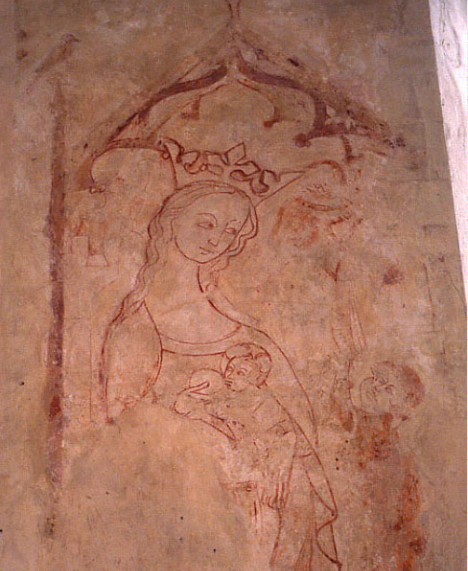
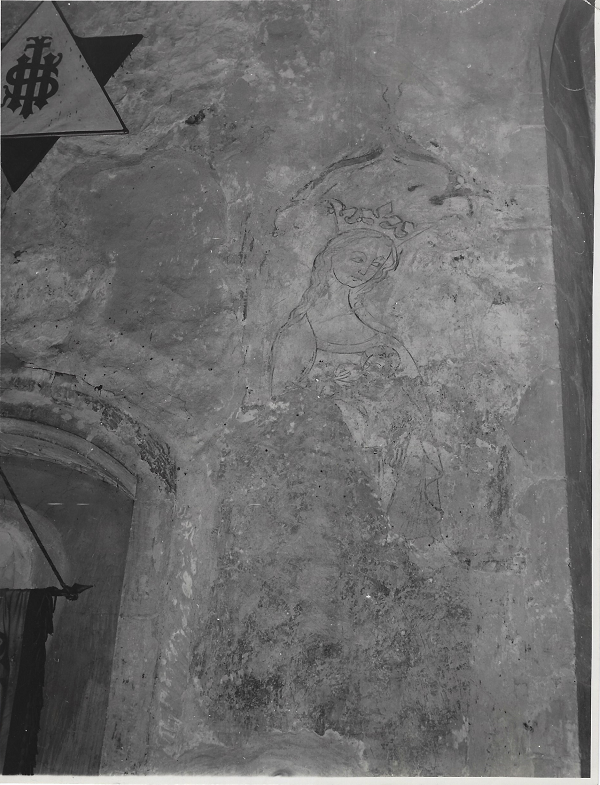
Also on the North Wall can be seen Mural Paintings of unusual interest, particularly that of the Madonna to whom the Church is dedicated.
Prior to 1962 this painting had been partially visible and in 1962, along with other paintings was restored by an expert who was a Mrs Baker;
she was engaged through the auspices of The Pilgrim Trust.
Her initial comments regarding the Madonna are as follows “I discovered a text partially obscuring the painting,
which is of 14th Century date. And I cleaned off the text to reveal an extremely lovely painting finely drawn and over life size
in scale. It is probably an altar painting,
bearing in mind the dedication of the church. I know of no better painting of this subject - it is the most entirely satisfactory
treatment I have ever seen”.
The Virgin is crowned with her long hair flowing over her shoulders, and she is suckling her Child who is
supported on her left knee, with tracings of censing angels
on either side and a bird can just be made out on top of the canopy - possible a falcon.
The boldness of the drawing and the treatment of the eyes are typical of the period (XIVth Century).
The long hair is said to have been a sign of virginity but the crown is unusual, although it has been known as far back as the XIIth Century when a sceptre was sometimes seen - as Queen of Heaven. The figure at the bottom right of the painting is thought to be the Patron worshipping the Virgin with his beads. The painting is reminiscent of that at Great Canfield in Essex, which is attributed to Matthew Paris, and could well be by the same hand.
"
Since starting this page it is now more likely that the painting of the Madonna is by
the monks of Earls Colne Priory
Further research leads the author to suspect that the painting was the hand of
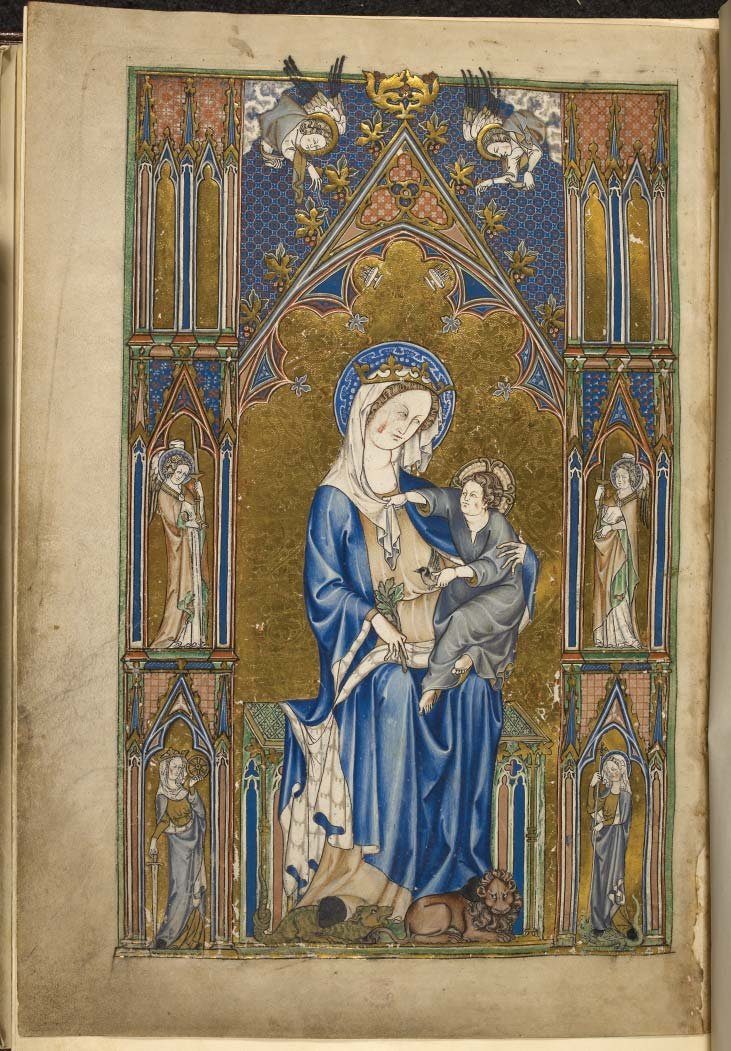
the monks of Earls Colne. The inspiration being images seen in the
de Lisle psalter.
The Text from the Painted Church: - Anne Marshall
"
Tristram has a brief description of this particularly beautiful painting of
the Virgin suckling the Christ Child, but only part of it was visible to him before it was restored by
Eve Baker for the Pilgrim Trust in 1962.²
The figures of the Virgin and the Child, along with the elaborate canopy above the Virgin’s head, need
little elucidation, beyond suggesting that this is a more obviously ‘devotional’ painting than those
at either Beckley (linked to a theme of Judgement and retribution) or Faversham (part of a Nativity series). There might once have been an altar below the painting, as suggested by Eve Baker, especially since censing angels were once visible on either side of the central group of figures.
There is certainly another figure visible – kneeling or standing at the lower right, with upraised hands.
Mrs Baker also suggested that this might be the patron praying his rosary (there is a group of red dots
that might be rosary beads). The church was in the patronage of the
Benedictine Priory of Earl’s Colne
in the 14th century, and this figure might indeed be the donor of the painting. A faint suggestion of
a tonsure on the kneeling man would support the idea, but I am nevertheless uncertain.
The unique feature here though is the inclusion of two perching birds. A small falcon or hawk, possibly a
kestrel or perhaps a sparrowhawk, appropriate to a cleric (the Canon Law prohibition on hawking by
priests was widely flouted), is on the central pinnacle of the canopy over the Virgin’s head, and a
smaller bird on the left-hand (onlooker’s viewpoint) finial of her throne. As well as these, there is
a suggestion that the kneeling figure is holding up before the Virgin something that might be another
bird, with narrow tapering wings held upright. An alternative or additional possibility then is that
this a man, donor or not, offering up an image of a hawk along with prayers for the healing of a real one, as in the well-documented 1368 case of Nicholas de Litlington, Abbot of Westminster³. At any rate it is hard to escape the feeling that the birds in this painting must have more than merely decorative significance.
Apart from the two paintings linked above on this page, there are very few other examples of the Virgin
suckling the Christ Child left in the English parish church; the only other one known to me,
at Great Canfield, also in Essex, will be here soon. All four of them show the Virgin crowned as
Queen of Heaven and with loose hair, as here.
References
The Church guide was originally authored by Samuel Philip Praymond in 1964.
C Reeves, Pleasures and Pastimes in Medieval England, Alan Sutton Publishing (Stroud, Glos.), 1995, p.112.
In Medieval Panorama, Cambridge, 1949, p.594, GG Coulton quotes Abbot Nicholas’s Account Roll – “Item:
for a waxen image of a falcon bought to offer [at the altar] for a sick falcon, 6d.”
Anne's reference to Tristan does not agree with my other research as the paintings would have been covered when he made his study. I guess she does say that the Madonna was partially visable, but I have not been able to locate the statement in Tristram's work