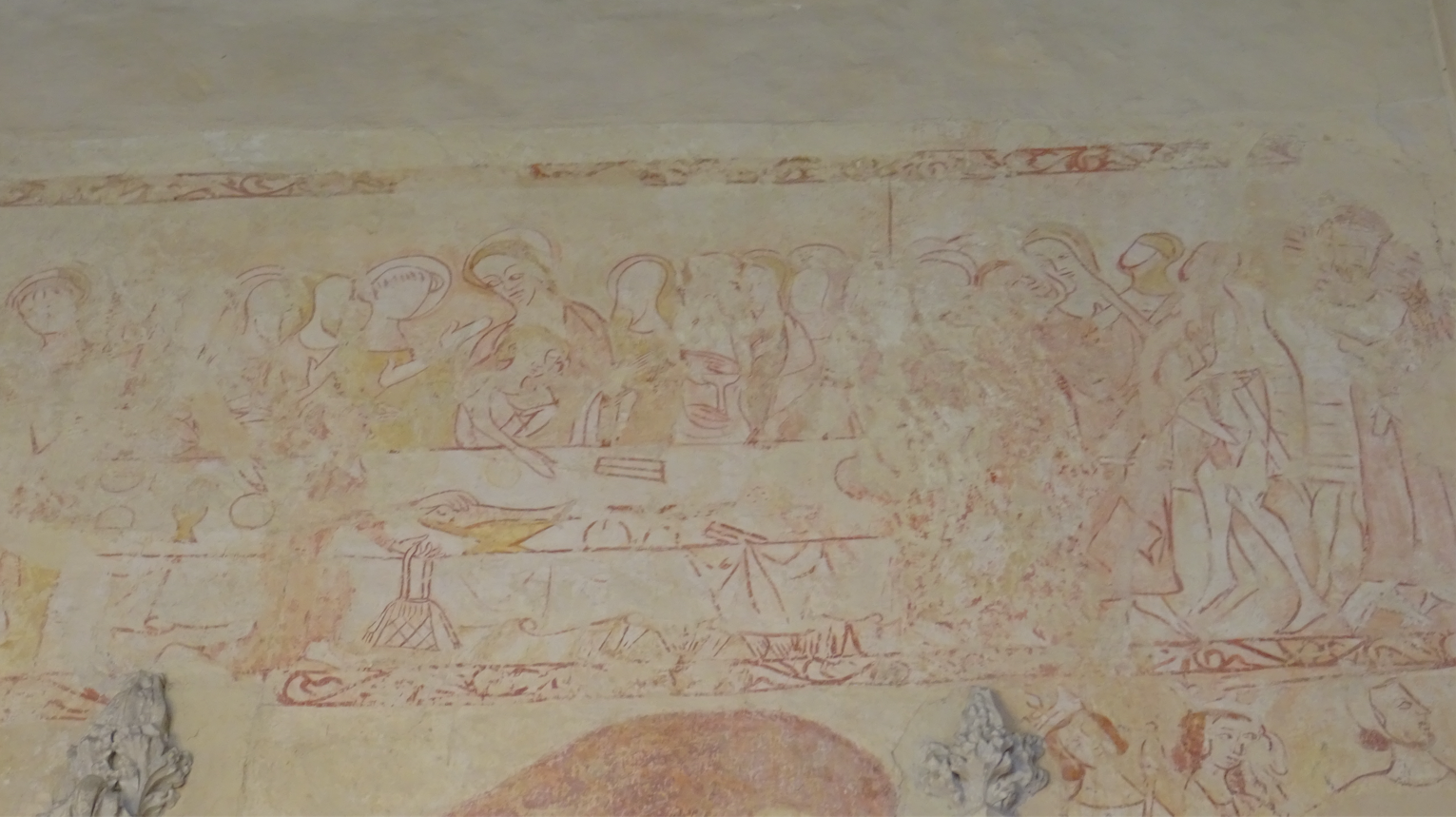
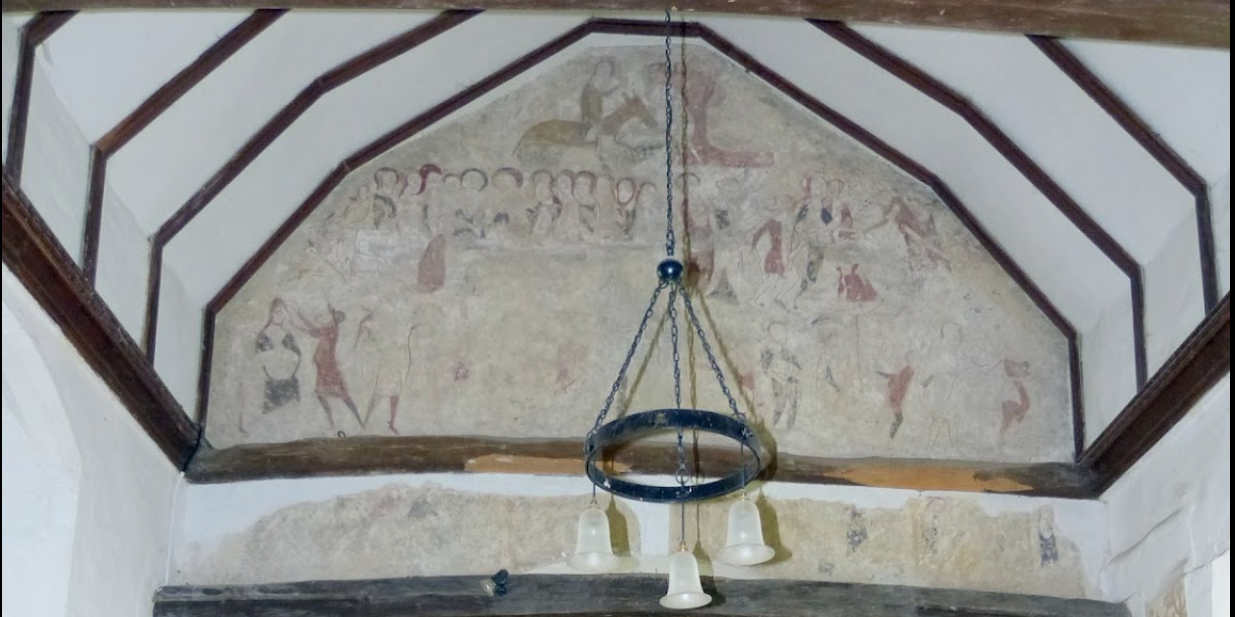
Part of the medieval wall painting of the Passion at Belchamp Walter
There are various interesting features of the depiction of the Last Supper
Searches for "The Last Supper and Belchamp Walter" may find this page. As opposed to "The passion".
April 2026 - Easter - saw access in log and my detail of Judas stealing a fish from the table had not been uploaded.
The Last Supper
The mural forms part of collection of wall paintings
in St. Mary's Belchamp Walter.
The Last Supper forms part of a "Passion Cycle". See Anne Marshall's
website The painted Church for more examples of Passion Cycles.
Top
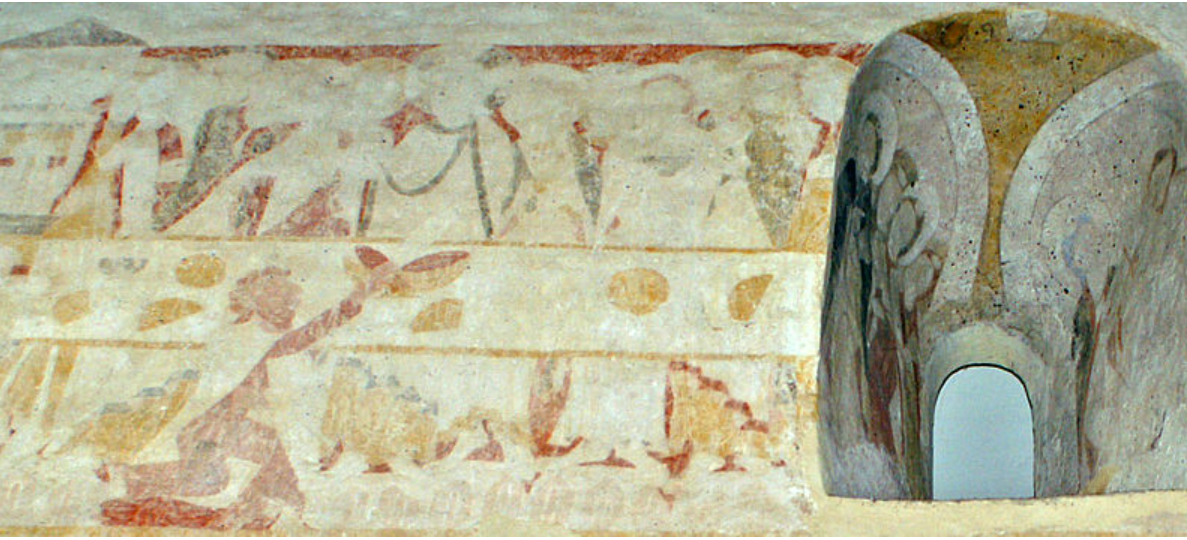
Judas stealing a fish
The interesting feature in the depiction of Last Supper at Belchamp Walter is that of Judas. Anne Marshall describes it below.
Ickleton, Cambridgeshire Passion Cycle 1150-1200 - A true frescoe - Anne Marshall.
The description below sounds very similar to what you see at Belchamp Walter
"
The Cycle as we have it begins at the west end (above) of the arcade, with a well-preserved Last Supper.
Judas is shown in his traditional position in early painting – on the opposite side of the table to everyone else.
He is in the act of taking a fish from a dish, placed immediately in front of Christ, on the table.
This may be intended to mean that Judas is a thief, or is greedily taking more than his share. Or of course the
appropriation of the fish may be heavily symbolic of his betrayal of Christ. Or both may be intended, as so often.
This particular iconographical detail is not unique in the history of art, but the only other example I know of in the English church is at Belchamp Walter in Essex.
"
In particular is the depiction of Judas stealing the bag of money and the fish.
What Anne says about the Last Supper at Belchamp Walter.
"
To judge by the number of heads on the figures sitting at the table of the Last Supper at the right, there is a full
complement of disciples here, and apparently some attendants, or perhaps more likely, some of the Holy Women, too.
Most conspicuous are Christ himself, the tallest figure, in the centre, ‘the disciple whom Jesus loved’, generally
taken to be St John, ‘leaning in His bosom’, as in John 13:21, and, very obviously singled out on the opposite side of
the table, Judas, whose figure is very unclear, perhaps as a result of deliberate, and early, damage. Very clear indeed, though, is the bag in which Judas carries the disciples’ money, a remarkable artefact indeed with its cross-hatched pattern, dangling from his left hand. With his right, Judas takes a fish from a dish beside him – a symbolic act, the significance of which is commented on in more detail on the page for the painting of the Last Supper at Ickleton, over the border in Cambridgeshire.
"

Detail of Judas stealing a fish
The image of Judas is not clear but we can clearly see the money bag in Judas' left hand the fish in his right.
According to Anne Marshall there is only one other example of this that she knows of:
This is at Ickleton, Cambridgeshire
"
An incomplete, but very fine Passion Cycle above the arches of the North Arcade. The excellent guidebook in the church
rightly describes its discovery as ‘of national importance’. These paintings are not only of very early (1150-1200) date, but also of the highest quality. More than that, they are a very rare example of ‘true fresco’ technique in English wall painting.
"
Fairstead
Bread and Wine
Jesus' knowledge of His impending condemnation to death at the Last Supper is rooted in His prophetic nature and the divine plan for salvation. He had foreseen this event, as recorded in the Synoptic Gospels, where He predicted His death three times, culminating in the crucifixion. Jesus' understanding of His death was deeply rooted in the Old Testament prophecies and the necessity of His sacrifice for humanity's redemption.
Matthew 20:17–19, Mark 10:32–34, and Luke 18:31–34 describe the third time Jesus predicted His death. He spoke to His disciples as they were heading up toward Jerusalem for Passover, and He told them how He would be mocked, scourged, crucified, and then rise again. On this occasion also, the disciples did not understand Jesus’ saying because the meaning was hidden from them. They would soon learn what Jesus meant in the events of Good Friday and following.