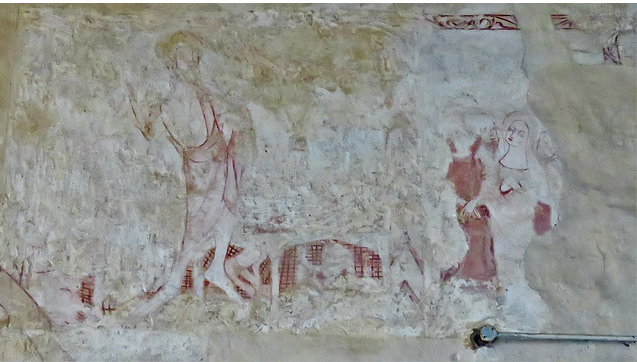
A medieval wall painting on the South wall of Belchamp Walter church
Page was visited February 2026.
Adding content. Mary Cleopa - Mary Salome - Mary Magdalene (sometimes alternated with Mary of Bethany)
March 2026 - as there is work being performed on the paintings and Easter is fast approaching it is good idea to update these pages.
While this painting on the South Wall was not specifically targeted for work in 2026 it has received some interest from Tom Organ. My suspicion is that he will be accessing these pages for backup information to put in his report. This ia a sad fact as there is little else out there, either on the Internet or stuffed away in someones drawers.
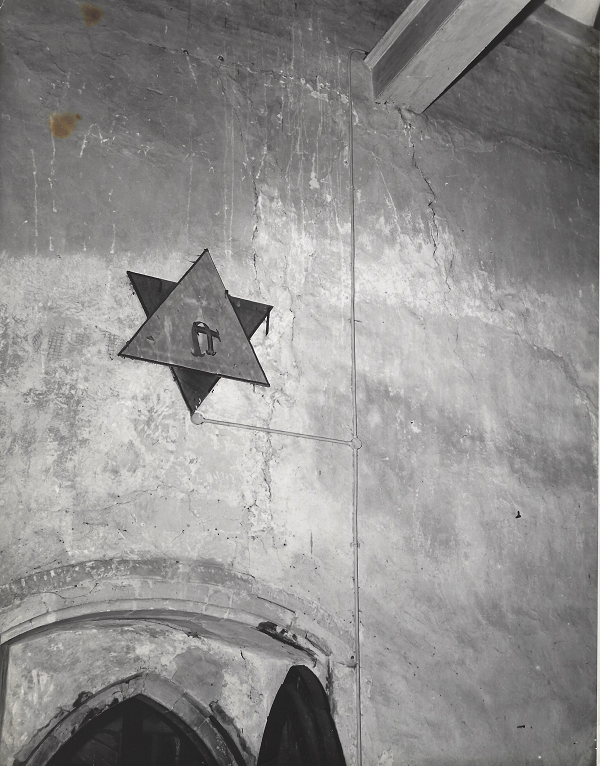
I have never see the significance or even the existance of the stars of David in the church. The reason that I have invcluded them on this page is that the star about the porch arch is where the Resurrection scene was painted. There is a sort of duality here in the a Jewish symbol be placed over a painting that some Christians believe was that of those that killed their Massiah. The vicar at the time could have been Rev. Trevor Howard.
The Three Marys - The Resurrection
The Resurrection Scene above the South door. One of the many 14th Century paintings in St. Mary.
Not easy to make out as it was painted on the South wall of the nave and in a similar manner to the others on this wall they have not survived as well as those on the North wall.
There are many interpretations of this painting and is undoubtedly a depiction of the resurrection of Christ and the Empty Tomb. The Women of Easter are shown by the tomb as are soldiers
Top
"
In 1964 Mrs Baker returned to look at the South Wall but the results were disappointing. The plaster on this wall being in poor condition, details had become obliterated, but portions of a roundel are seen depicting a figure with arrows and a woman. This is possibly Saint Sebastian, who was wounded with arrows shot at him, the archers leaving him for dead.
His wounds were healed by Irene, widow of the martyr Saint Castulus.
"
"
On the South side above the door there appears to be three women with Christ - the Resurrection Scene?
Especially as there seems to be a sleeping figure near his right foot.
"
"
To the right of the door is an inscription in Old English, this is of a much later date and quotes from the Acts of the Apostles (Chapter 20, verse 9):
“And there sat in a window a certain young man named Eutychus, being fallen asleep; and as Paul was long preaching, he sank down with sleep and, fell down from the third loft, and was taken up dead”, however the narrative goes on to say he recovered.
"
"
In 1996 the whole of the walls containing the paintings was stabilised and cleaned.
"
Mrs Baker and her team of conservators uncovered the wall paintings on the North wall in 1962.
The paintings on the South wall were not visable at that time, although it was suspected that there may have been some due to the discovery of those on the North wall.
The Resurrection painting that we see today had an electical fitting and a pipe punched through the wall to supply lighting in the porch. This was unsympathetically done in hindsight but at the time the painting was not known.
Even more strange is the stars of David that were placed on the North and South walls, see below, the star on the South door to the porch was placed directly over the Three Marys (Resurrection scene).
Interpretation
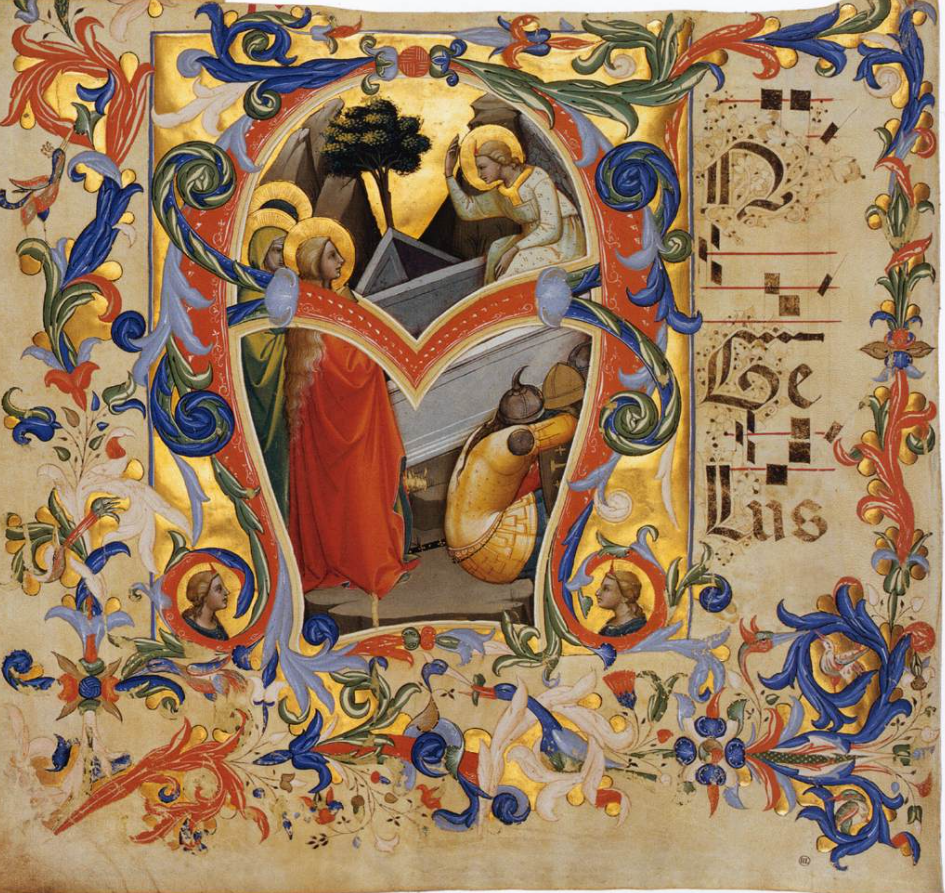
According to WikiP the Marys that are generally depicted at the tomb of Jesus the Virgin Mary was not one
of them.
- Mary Clopas (sometimes alternated with Mary Jacob) – holding a broom
- Mary Salome – holding a thurible or censer
- Mary Magdalene (sometimes alternated with Mary of Bethany) – holding an alabaster chalice or jar.
Lorenzo Monaco, The Three Marys at the Tomb
As I was saying the wall painting at Belchamp Walter is not easy to make out. In fact it is pretty much indecipherable. There are obvious figures in the composition and the main character is described as Christ by Eve Baker and she states that the sleeping figure at his feet as "especial".
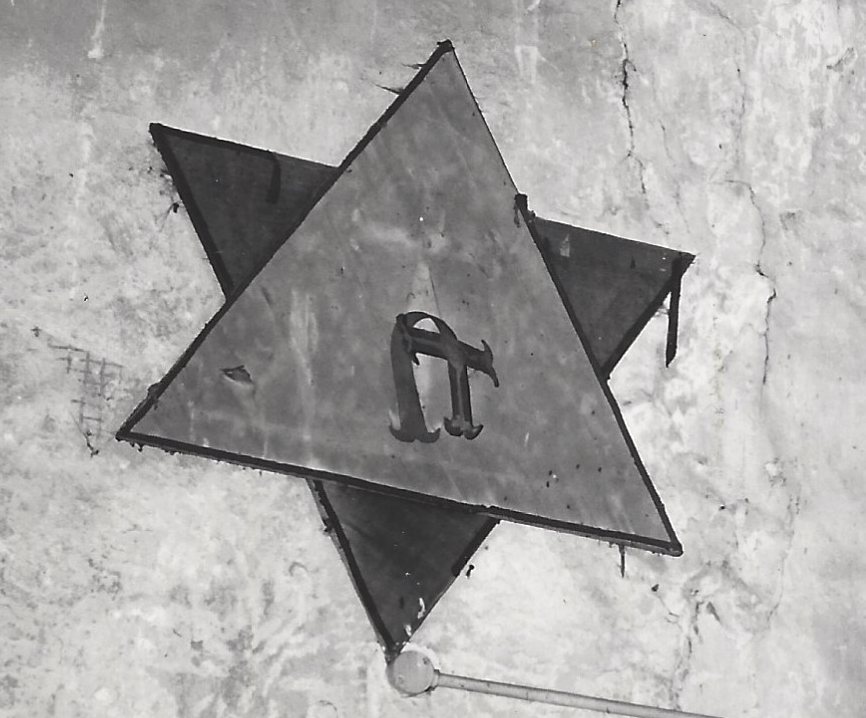
The star of David above the South Door
Below is a photograph of a star of David above the South door of St. Mary's Belchamp Walter. It seems it was painted over the mural of the Three Marys.
The presence of this star is a bit of a mystery as it also reflects some of the other Jewish symbology in
St. Mary's.
Clopas
Mary Clopas is thought to have been one of the Marys that is depicted in paintings of the resurrection. I guess that it makes sense that someone would bring supplies for a funeral.
"
According to the Gospel of John, Mary of Clopas (Ancient Greek: Μαρία ἡ τοῦ Κλωπᾶ, María hē toû Clōpâ) was one of the women present at the crucifixion of Jesus and bringing supplies for his funeral. The expression Mary of Clopas in the Greek text is ambiguous as to whether Mary was the daughter or wife of Clopas, but exegesis has commonly favoured the reading "wife of Clopas". Hegesippus identified Clopas as a brother of Joseph.[1] In the latest official edition of the Roman Martyrology of the Catholic Church she is commemorated with Salome on April 24.[2]
Along with Mary Magdalene and "Mary" Salome, Mary of Clopas is known as one of the Three Marys at the tomb of Jesus. Her relics are said to be in France at the Church of the Saintes Maries de la Mer.
"
Mary Salome
Mary Salome was another that is depicted at the Tomb of Jesus.
"
In the New Testament, Salome was a follower of Jesus who appears briefly in the canonical gospels and in apocryphal writings.
She is named by Mark as present at the crucifixion and as one of the Myrrhbearers, the women who found Jesus's empty tomb.
Interpretation has further identified her with other women who are mentioned but not named in the canonical gospels.
In particular, she is often identified as the wife of Zebedee, the mother of James and John, two of the Twelve apostles.[2]
In medieval tradition Salome (as Mary Salome) was counted as one of the Three Marys who were daughters of Saint Anne, so making her the sister or half-sister of Mary, mother of Jesus.[3]
"
Mary Magdalene
This Mary is widely recorded as being present at the resurrection.
The Wikipedia page says:
"
Mary Magdalene[a] (sometimes called Mary of Magdala, or simply the Magdalene or the Madeleine) was a woman who, according to the four canonical gospels, travelled with Jesus as one of his followers and was a witness to his crucifixion and resurrection.[1]
In Gnostic writings, Mary Magdalene is depicted as Jesus's closest disciple who uniquely understood his teachings, causing tension with Peter, and is honoured as the "apostle to the apostles".
"
In Gnostic terms the role of Mary Madeleine could be seen as an alternative view of her possible relationship with Jesus.
The Women of Easter
My understanding was that the Women of Easter were those gathered outside Jesus's tomb, i.e. The Three Marys.
The significance of the Passion and the Resurrection paintings in the church of St. Mary Belchamp Walter should be of great importance to those of faith. It would seem that this is not the case as the attendance at services at Easter are not particularly well attended , unlike Christmas.